
In this lesson, you’ll learn how to use common Icelandic verbs in the present tense and how to conjugate them.
In Icelandic, the verb is the center of the sentence. Most sentences are built around a verb. A sentence can even consist of one single verb.
| Icelandic | English |
|---|---|
| að heita | to be called |
| að búa | to live (somewhere) |
| að eiga | to own |
| að tala | to talk/speak |
| í | in |
| á | on |
| sveit | countryside or farm |
| borg | city |
| heima | home |
| íslenska | Icelandic |
| enska | English |
| pólska | Polish |
| spænska | Spanish |
🎧 Listen to the new vocabulary here! 🎧
In the infinitive, most Icelandic verbs end in -a (for example: að vera, að heita). The verbs in Icelandic determine the case of the subsequent nouns, pronouns and adjectives of a sentence. For example: ég tala íslensku* (I speak Icelandic). The verb að tala requires that the noun íslenska (Icelandic) should take the accusative case. We’ll dive deeper into grammatical cases in later lessons.
Just like in English and many other languages, verbs in Icelandic change form (conjugate) depending on the subject. Most verbs conjugate in a smiliar manner. There’s no way of knowing how to conjugate each verb based on the infinitive. This has to be memorized.
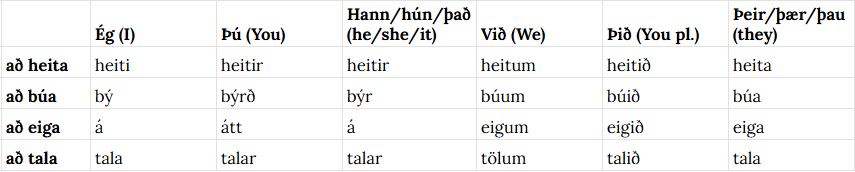
Fill in the correct form of the verb and then translate the sentences.
1. Ég ___________ (að tala) íslensku.
2. Hann ________ (að tala) ensku.
3. Við _________ (að heita) Aldís og Georg.
4. Þú ________ (að heita) Ísabella.
5. Þau _______ (að búa) í Reykjavík.
6. Þið _______ (að búa) í sveit.
7. Ég _______ (að eiga) heima í borg.*
8. Hún _______ (að eiga) heima á Akureyri.*
9. Við _______ (að tala) spænsku.
10. Þú ______ (að heita) Andrés.
11. Þær _______ (að búa) á Höfn.
12. Þið _______ (að eiga) barn.*
Að eiga heima also means to live somewhere, similar to að búa. The literal meaning is “to own a home.” The verb að eiga (“to own”) is sometimes used in Icelandic in a way similar to to have in English, so the phrase can be understood as “to have a home somewhere.” You can see this in the sentence „Ég á barn.“ It means “I have a child,” but the literal translation is “I own a child.”
For example:
„Ég á heima í Keflavík.“
„Ég bý í Keflavík.“
Both sentences mean “I live in Keflavík.”
The prepositions í (“in”) and á (“on”) are often used in very similar contexts, and language learners frequently find it difficult to know which one to use.
For example, in Icelandic you are in a store but on a airport. You are in Sweden but on Spain.
There is no strict rule that determines which preposition should be used. The choice simply depends on how native speakers traditionally think about a place, whether they feel they are “in” it or “on” it.
Because of this, the most reliable approach for language learners is to learn the correct preposition together with each place name.
Rewrite the sentence with a new subject. Then translate the sentences.
Example:
Ég tala íslensku. → Þú talar íslensku.
Ég tala. → __________________________
Ég heiti Árni. → __________________________
Ég tala íslensku. → __________________________
Ég á barn. → __________________________
Ég bý í Ólafsvík. → __________________________
Ég tala ensku. → __________________________
Við tölum ensku. → __________________________
Við eigum barn. → __________________________
Við búum á Hólmavík. → __________________________
Við eigum heima á Þórshöfn. → __________________________
Við heitum Páll og Thelma. → __________________________
Við tölum spænsku. → __________________________
Write one simple sentence with each verb:
Play the recording. Write the full sentence.
Try to read by yourself and then repeat after the audio (coming soon):
Ég tala íslensku.
Þið talið ensku.
Þær búa í borg.
Þú býrð í sveit.
Þau eiga barn.
Hún á heima í New York.
Hann býr á Stokkseyri.
Ég bý á Þingeyri.
Alma: Góðan daginn. Hvað heitir þú?
Bríet: Góðan dag. Ég heiti Bríet. En þú?
Alma: Ég heiti Alma. Hvernig hefur þú það?
Bríet: Ég hef það fínt. Býrð þú í sveit?
Alma: Nei, ég bý í borg. Talar þú spænsku?
Bríet: Já, ég tala spænsku, ensku og íslensku. En þú?
Alma: Ég tala spænsku og íslensku.
Questions:
Good job! Vel gert!
Here you can find the answers to the written practices.
a) 1. tala, 2. talar, 3. heitum, 4. heitir, 5. búa, 6. búið, 7. á, 8. á, 9. tölum, 10. heitir, 11. búa, 12. eigið.
b) Many correct answers, for example these: 1. Þú talar., 2. Hann heitir Árni., 3. Hún talar íslensku., 4. Þú átt barn., 5. Hann býr í Ólafsvík., 6. Hún talar ensku., 7. Þið talið ensku., 8. Þeir eiga barn., 9. Þær búa á Hólmavík., 10. Þau eiga heima á Þórshöfn., 11. Þið heitið Páll og Thelma., 12. Þau tala spænsku.
c) Many correct answers, for example: 1. Þú heitir Jón., 2. Hann á heima í Reykjavík., 3. Ég bý í París., 4. Þau tala pólsku.
1) Hann talar spænsku. 2) Þau búa í London. 3) Við eigum heima í Reykjavík. 4) Þú átt barn. 5) Ég tala ensku og pólsku.
b) 1. Þær heita Alma og Bríet. 2. Já, Bríet talar íslensku. 3. Nei, Alma býr í borg.